Showing posts with label Painting. Show all posts

Saturday, 11 December 2021

A Favorite Painter

I put on my green and white striped suit and walked into Arco, the huge art fair in Madrid. It was right before the pandemic and the place was packed with gallerists, collectors, artists and their admirers. One painting stood out from all the other works: ‘Quiet Listening’ by Peter Uka. The painting depicted an elegant young man listening to records. It sang of another era and yet it is completely contemporary. It spoke of memory, music, and beauty. This summer (2021) I was delighted to interview Peter Uka for Metal magazine. We talked about art, music, 1970s culture, and identity. You can read the full article here

Visit Peter Uka’s solo exhibition, ‘Longing’, at Mariane Ibrahim gallery if you happen to be in Chicago. It’s on view until January 15th, 2022. 


Peter Uka, Quiet Listening, 2020. Courtesy the Artist and Mariane Ibrahim

Denge Pose II, 2018. Courtesy the Artist and Mariane Ibrahim

Peter Uka, Still Riding 2, 2021. Courtesy of Mariane Ibrahim

Friday, 16 April 2021

Come Into The Fortunyverse

Exciting news: I have a new artist website! You can see my drawings, performance art (yes, I love rubbing paint on naked skin, dancing at bus stops,  and lifting shamans into the air), photography, and paintings at thefortunyverse.com. Check out www.thefortunyverse.com and let me know what you think.


Tuesday, 7 April 2015

An Interview with the Wonderful Stanley Donwood

I met Stanley Donwood a few years ago in a basement in Soho. I heard it used to be a sex dungeon. By the time I was sitting across from him at a small wooden table it had turned into an art gallery. It was a pleasure chatting with him. Donwood is the kind of intuitive and intelligent man that you wish would appear on your left at every dinner party. Below is our interview, published in Exit magazine.


DRAWING HOOKS OUT OF YOUR THROAT

Stanley Donwood is an English artist and writer who is famous for designing Radiohead’s album artwork.  He has been collaborating with Thom Yorke for almost two decades. Donwood runs a studio called Slowly Downward Manufactory and he regularly exhibits his distinctive linocuts, paintings, and drawings in galleries around the world.  When not creating visual art, he writes dark but lively prose. EXIT met up with Donwood before his recent show at the Outsider’s Gallery in London to discuss the next Radiohead album, Thom Yorke, writing, and how temperature affects art.

The next Radiohead album is described as a newspaper album with tiny pieces of artwork held together with plastic. What was the inspiration behind the design?

I’ve always really loved newspapers, their tactile quality, that crappy paper. Newspapers are on their way out. I like dying media. They have a poignancy that I don’t find in things like Twitter. But maybe when Twitter is dying maybe the last Tweet will be the saddest thing we’ve heard for years. The last daily newspaper we can buy will be an impossibly sad thing. So I wanted to use the format of a newspaper because a newspaper doesn’t pretend to be anything other than of the moment. Because a newspaper is so ephemeral that if you leave it out in the sunlight it will decay and go yellow and if you leave it out long enough there will be nothing left. (For this album) I wanted to make the opposite of an archival quality coffee table book. No future.

What’s Thom Yorke like? Is he quite serious? I read that when you collaborate one of you does something then the other destroys it. Then you mend it back and forth.

It depends on the time of day. We get on very well. We haven’t had an argument yet in twenty years. We just destroy each other’s work and then keep working at it. Keep battling until you get to the point where the conflict is resolved and that’s the end.  We both like it after a lot of toing and froing.

Do you find English weather and temperament inspirational or limiting? 

I don’t know. It’s an interesting idea. My dad always said the reason why the industrial revolution happened in England was because it’s so miserable that people are just desperate for something to do… There’s something about the pessimism that when I’m not here after a while I miss it. I really like the Mediterranean and California, places where it’s sunny and nice. You can do nothing (there.) I love it. Essentially I’m extremely lazy. Something in the appalling weather in this country forces me to go do something… to keep warm, half the time.

I agree. I’m so much happier in warm weather, but it’s hard getting anything done.

Exactly! But what’s the point of getting anything done? It’s natural to not do anything.

I thought, I’ve got some books in my head; I should go somewhere cold.

If you want to be miserable, go to Scandanavia. (He jokes) I’ve got this weird fascination with Scandinavia, places like Sweden, Norway and Iceland. I’ve never been but I’d like to go. Just to see what would happen. I’m really interested in snow, whiteness, and the idea of where the land and the sky blurs. Like when you’re on a boat and there’s really bad weather and you can’t see what’s the sky and what’s the sea. I imagine it’s like that in Northern latitudes. Is that snow falling or settling? It correlates with your mind. You don’t know what’s up or what’s down, what’s far or what’s near.

Is bleakness required for good art?

No, though I see what you’re saying. I really like the Aboriginal art that is done in a very bright, sunny environment, and all those dots and dream paintings. That very colourful style of painting. You also get that with the French Impressionists when they were down in the Southern regions of France…and the Fauves, they were called Wild Beasts. I didn’t quite understand it until I went down to some of the towns where the Fauves were. They were doing this artwork that was very bright, messy and amazing.  I got there and after a few days I realized why you would make work like that because that’s how you feel. Bright, messy and amazing. There’s nothing wrong with that. I like that. Where I come from, artwork is more didactic.

To what extent does art history and political history inform what you’re doing now?

Probably a lot more than I think. Art history is something that I’m incredibly ignorant about.  I went to Art College but I was sufficiently arrogant to not go to any of the lectures about art history, little bastard. Since then I’ve started to learn about art history and political history. So I’ve read lots of books about it and it’s made me realize how little I actually know. The certainties I held when I was 20 are now uncertainties at the best, vagrancies at the worst.  Vague ideas.

There is a lot of writing on your website. Do you spend more time writing or doing visual art?

There is some kind of weird lock in my brain if I can’t work visually. I spend a lot of nights not being able to think then I start thinking I’m really shit, I should stop and get a job. That’s when I’m really low.  I can’t do any visual artwork and that’s when I write, usually quite late at night.  Then the other thing happens. I think what I’ve written is atrocious and despicable. Then I start doing artwork again. I can’t do the two at the same time. It’s impossible. It’s over a couple of weeks. One will fail and then one will emerge.  Writing particularly is like drawing fish hooks out of your throat. It’s horrible. But necessary. Because you can’t leave them there.

Interview by Margo Fortuny. Exit Magazine, Spring/Summer 2011
_____________________________________________________

Check out Donwood's new J.G. Ballard-inspired exhibition 'Dream Cargo' at the Lawrence Alkin Gallery in London through April 25th, 2015. 


Kindness of Women, Stanley Donwood, 2015


Faber & Faber have recently published several books by Stanley Donwood, which can be found here. 


Thursday, 26 March 2015

Tea with Alan Aldridge


Penguin books, the 60s, psychedelia… Here's what we talked about the first time we had tea. You can read my interview with the cult artist below.


The Man with Kaleidoscope Eyes

Alan Aldridge grew up in East London and moved to Los Angeles 28 years ago. In his early 20s, the young artist went from unemployed and unknown to a designer at the Sunday Times in four months. At first, he received hate mail for his unconventional depictions. Aldridge became the art director of Penguin a year later. Soon after, he was illustrating for the Beatles, drawing posters for Warhol, and hanging out with rock stars. Aldridge created album covers for the Who, Elton John, Cream, and the Rolling Stones. He also made successful children’s books filled with colourful beasts. Film deals, beauties, and traveling around the world factored in along with creative output. Aldridge is currently writing a book called Pandemonium, which is out next spring. I met up with the charming man in Soho to talk about his past and thoughts about the future.

When did you start drawing and designing?

We’ll get one story straight. I wasn’t good at art in school. In fact, one term I came bottom in the class. When the teacher read out the results, I kept thinking he would call my name out next, but no, it was so-and-so, and then so-and-so, “And last of all, Alan Aldridge, 3/100.”   He glared at me; he thought I could do better than that. I mean, I wasn’t really trying, so he said, “Aldridge, you would’ve gotten 4/100 if you’d spelled your name right.”

 I didn’t start drawing until my 20s, and that was drawing in bars, trying to sell portraits and they were all terrible. Never sold one. Then I went to a graphic workshop, because it said Free Coffee on its flyer, which I thought was really weird, ‘cause the flyer was in a coffee shop, so I went and it turned out to be a class for graphic design. I convinced the guys that ran it that I was broke and they let me sit at the back. It was a ten-week course, twice a week. Slowly I got into it and finally I won the big prize, to do a Penguin book for twenty-five pounds. Very quickly after that, Germano Facetti who was head of Penguin’s design group started giving me work and one of the jobs he gave me was a book called Private View by Lord Snowdon so I had to go to the palace. I became very good at putting layouts together. At the end of the gig, Lord Snowdon recommended me to the Sunday Times, which at that point had one of the best design groups in Europe. So I go along to the interview and I get the job. I had gone from literally nothing to the Sunday Times in about four months. I had only been there a year when I became art director at Penguin.

How did you shake up the place when you were designing the Penguin book covers in 1965-67?

Well I was made art director, so I was the boss. It’s a funny story-I was getting to have a reputation and I had done some Penguin books because I had won a prize with the graphic workshop. I won first prize to do a Penguin cover and the art director at Penguin liked me so much he gave me two or three covers to do a week. Then the boss at Penguin, a guy called Tony Godwin  said, “Alan, you’re kind of trendy and know everyone. Do you know somebody, an American, to take over as art director of Penguin?”   I said “Yeah, I do know someone, ME.” And he laughed and I laughed cause it was kind of a joke to think you could be only a year at Sunday Times and then become head of Penguin Books art department. I forgot about it and then two weeks later, he called me up and said, “Do you still want the job?”  I said, “What job?”  And he said, “The art director of Penguin.”  I said, “Are you kidding me?”  He said, “No, it’s yours.”  I was twenty-three or twenty-four at the time. I had only been in the art business for two years, three at the most. Suddenly I was art director of Penguin and I brought my friends in to do the work in the studio. I started to get photographers and designers involved. We threw out the old grid; it was good fun.

 Your Chelsea Girls poster is famous.  How did you get to know Andy Warhol?

 He didn’t ask me personally. There was a place called Arts Lab in Covent Garden, which is a real bohemian, existential, beat generation kind of a joint. They were putting on the Chelsea Girls premiere. Somebody at Arts Lab called and told me Andy Warhol had asked if I’d do the poster, something like that. The poster became more famous than the movie.

Do you see any parallels with the creativity and upheaval of the 60s and the current cultural climate?

No, the difference between the 60s and now, is that the 60s already broke all the barriers: graphically, musically…if you listen to 50s music and the transition into 60s music, it was partly a drug culture as well which took over. There was colour in magazines. Colour became prevalent, as opposed to black and white magazines. It was like the whole younger generation wanted to try out everything...and did. Today it would be very hard to say your vision is unique when so much has already paved the way before you. My drawings had no precedent in the 50s or early 60s. I drew whatever came into my head and I guess that, in its own way, is revolutionary.

I know a lot of people who are obsessed with the 60s and particularly influenced by the style and music of that time. It’s as if there is an imagined nostalgia for a superior era.

Well, 1967 was voted the year of the century, primarily because of Sgt. Pepper. The 60s are all about free love. I mean, I didn’t see too much of that…there were a lot of concerts, a lot of drugs, people were taking their clothes off. That didn’t happen in the 50s…Some of the Pop Art was spectacular.

 Is there anything left to discover?

Oh yeah: computer art. You see what kids are doing in Photoshop. I find it very creative but it’s also cold. It’s almost like no hand has ever touched it. It’s very technical. I think my stuff has a bit of spirit to it.

Do you listen to music when you work?

I have an itunes electronica channel on all the time: XTC. It’s techno mostly.

What is your favorite book?

 Breaking Open the Head by Daniel Pinchbeck. It’s about Shamanism and the effects of psychedelic drugs.

What do you think is the most mind-expanding art out there?

It really depends on the viewer I think. I once when to Ghent in Belgium to see the Jan van Eyck altarpiece, the triptych, and nothing has every blown me away quite like that. At the same time I could look at psychedelic art and feel far less tripped out by it because it’s something I can understand. Jan van Eyck’s paintings don’t seem human to me. It was something that said to me technically you can get a lot better if you try. He was a genius.


Then I suggest playing Exquisite Corpse. We whip up some pictures of hybrid creatures while he regales me with stories about when he was a teenage butcher and old East London. Back when Shoreditch was the roughest part of London, the pub Dirty Dicks used to have dead cats nailed to the wall. But Shoreditch has changed; they took the cats down and Alan Aldridge hasn’t been back since. 

-Words and interview by Margo Fortuny. Published in Exit Magazine, 2008.


Thursday, 22 March 2012

mind scrape

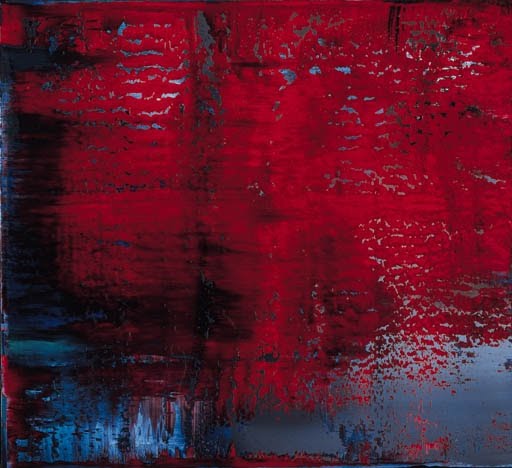
Gerhard Richter, Bach (1) 1992, Oil on canvas


Gerhard Richter, 1990, Oil on canvas, The Carnegie Museum of Art, Pittsburgh


“Abstract painting illustrates nothing…allows ourselves to see the unseeable that has never been seen and indeed is not visible. This is not an artful game, it is a necessity: since everything unknown frightens us and fills us with hope at the same time, we take these images as a possible explanation of the unexplicable or at least a way of dealing with it. Thus paintings are all the better, the more beautiful, intelligent, crazy and extreme, the more clearly perceptible and the less they are decipherable metaphors for this incomprehensible reality.”
-Gerhard Richter, 1979.

Gerhard Richter, 1991, Oil on canvas


The retrospective exhibition Gerhard Richter: Panorama is on through May 13th 2012, at the Neue Nationalgalerie
in Berlin. You can read about upcoming exhibitions here.

Gerhard Richter, 1987, Oil on canvas